Archive

Archive for the ‘values’ Category

Farm hour: Journey with apples that rock

February 9th, 2013 No comments

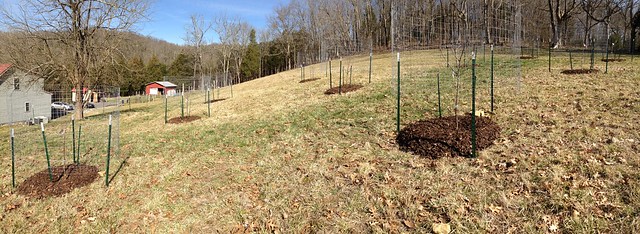
apple orchard
Freshly mulched apple trees in the orchard.

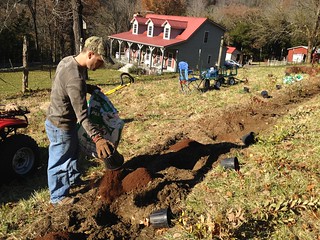
The apple compost pile was loaded with fat earthworms, so Vince had us use the rake instead of the shovel to bin it up and move it to the apple trees.

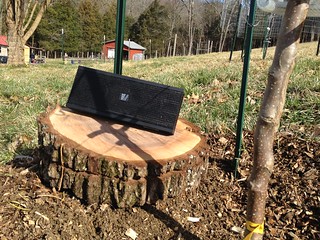
apple rockWe had just enough for the ten trees. The compost looks good, but I’m sure our next batch will be even better now that we’re able to process the carbon inputs with the chipper.
Speaking of inputs, I treated the orchard to Journey’s “Anytime” from their Infinity album through this wireless speaker Vince picked up.

Journey is not on the OMRI list of approved organic inputs for apples, but the official entry to the USDA reads: “This is how we make them rock.”

Farm hour: Purple Martins are nature’s bug zappers

February 3rd, 2013 No comments

purple martin housePart of our organic farm’s integrated pest management plan calls for the use of hosted beneficial birds as natural predators. Earlier this week I asked a couple of friends and folks at the Tennessee Wildlife Resources Agency (TWRA) for some advice and was reminded about the amazing Purple Martin.
Growing up in the South, I remember Purple Martin houses on several farms. I never really thought there was a functional reason for hosting them, and later was convinced all they ate were mosquitoes.

I was wrong. State Zoologist David Withers sent me this great one pager from the Purple Martin Conservation Association that basically tells me the Purple Martin is one of nature’s best bug zappers. Check out TWRA’s wonderful online resource on common birds and how to host them.

Even if you are not an organic farmer, hosting Purple Martins can dramatically help reduce any flying insect pest on your property while reducing the use of chemical sprays and inviting a little of nature’s perfect aesthetic back to your home life.

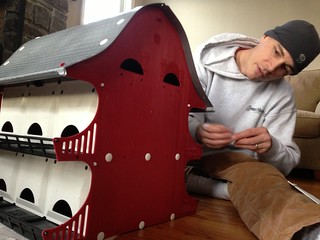
We got two 16 family houses, both made in America, at our local Tractor Supply Company (photo: Vince snaps a Purple Martin house together). We’re using cut cedar posts from the property and will open the houses March 31 or as close to the time we begin seeing younger Purple Martins.

Here are a few points we’ve learned through some voracious reading over the past couple of snow days:

  • Purple Martins overwinter in Brazil and return year after year to the same nesting location.
  • They live exclusively in human made housing (East of the Rocky Mountains)
  • Houses must be over 10 feet off the ground, a minimum of 30 feet from a human dwelling (120 feet maximum), about 45 feet from any tree or bush and have nothing touching the pole, including support wires. Nothing around the housing can be taller.
  • Entry holes must be a specific dimension or competing birds become a problem (3 inches wide and 1 3/16 tall).
  • Purple Martins prefer white colored housing.
  • To attract a colony you must open the house when last year’s young return – 3 weeks after the first adults arrive. In Tennessee, adults arrive March 1-15. Adults will also colonize, but you must be persistent to scare off competing birds.
  • Purple Martins diet includes “dragonflies, damselflies, flies, midges, mayflies, stinkbugs, leafhoppers, Japanese beetles, June bugs, butterflies, moths, grasshoppers, cicadas, bees, wasps, flying ants, and ballooning spiders.”
  • Once hatched, Purple martins develop in about 30 days.
  • You can handle the chicks to manage the nests – parents do not mind human handling or scent.

Farm hour: preventing herbicidal drift from utility right of ways

January 28th, 2013 2 comments

zona organicaI didn’t know what to expect working with local utilities to prevent drift from chemical management of right of ways onto our organic farm.
Each of our local utilities who need access to the front of the farm had never dealt with a request like this, but each one totally understood my goals and appreciated my willingness to help them manage right of ways without chemicals.

The key phrase there is “my willingness to help them.” That’s a commitment to some work on my part. Luckily the right of ways are down hill a good distance from the fields we are certifying as organic, but we’ll have to dedicate some weekend farm hours to clearing brush.

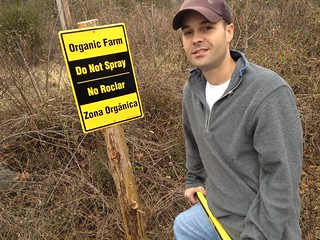
Some practical advice I got from Middle Tennessee Electric Membership Cooperative was to make sure bilingual signs were posted. I can send them 50 letters, but a sign is all the contracted crews managing vegetation will see.

We got this embossed aluminum 12×18 “Do Not Spray” sign online. If you are going through the process of becoming a USDA Certified Organic farm, your certifying agent can help you with draft letters to neighbors and local utilities.

Farm hour: becoming a USDA Certified Organic farm

January 9th, 2013 No comments

soil tests
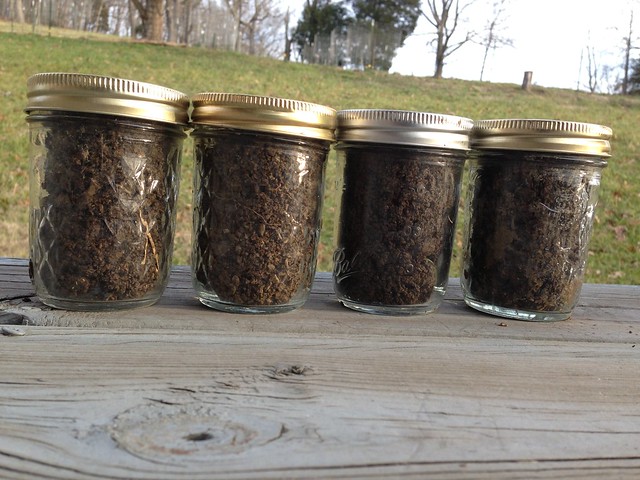
soil samples from four sections of the farm

It’s Winter. There isn’t enough light in the day when we get home from work to do much on the farm, so we’re taking a 15 hour online course from the Rodale Institute to apply to become a USDA Certified Organic Farm. Every night’s a school night until the days get longer.

We’re learning a lot. Even if you don’t plan to become certified the program is a wealth of information to suppliment and reinforce your interest in sustainable farm practices. One of the most important things I’m learning about is building soil fertility and conservation. It’s also required by the federal government for certified producers to have plans in place to achieve that, such as amending the soil with composts and both animal and green manures as well as using cover and rotational crops.

Hour by hour – we’re hoping to have a decent Organic System Plan hammered out this month for our farm’s application. One of the first steps was to get a baseline measurement of our soil, so I took samples from four sections of field (each section with a few sample points) and sent it off for testing through the local Farmer’s CO-OP. I can’t say for sure, but the soil looks amazing. We’ll see what the test says.

Farm hour: climbing the hill

November 21st, 2012 1 comment

4 wheeler
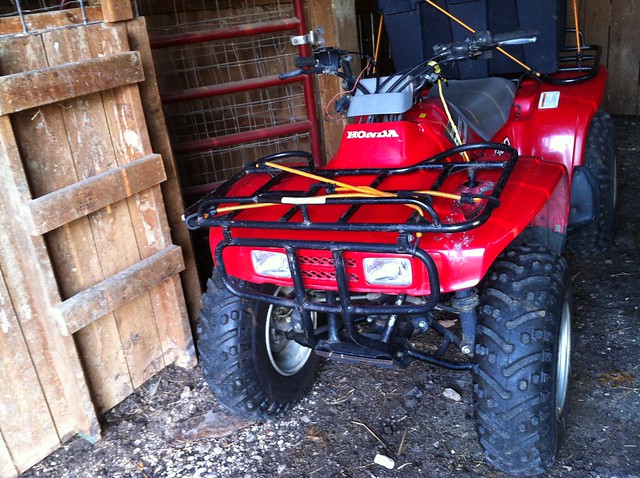
Grandpa’s old 4 wheeler

Farming is hard work, and it’s harder to imagine doing it without help. Hours make days like help makes it done, and it took a lot of both to plant the orchard last week.

I squeezed a month of farm hours into a week with some vacation time and figured out how farmers can go through so many chicken eggs every day. You get real hungry! After shoveling 3-4 tons of material (wood chip mulch, manure and dirt), tilling, moving rocks, water and planting 25 trees and bushes, breakfast looks good any time of the day.

4 wheelerNoah let me borrow his truck. We may have enough mulch to last 2 years now! Tim gave us the pine needles we needed to keep the blueberries happy. Len let me hop the fence for the cow manure our compost piles needed to come to life. Benny did the same, letting me drive all over his farm shoveling up horse manure. It all adds up to tons of help, literally.

But the one thing that came just in time to really bring the help together was a gift from my step dad: Grandpa’s old 4 wheeler. It’s got its problems, but it was the week’s work horse hauling everything up and down the hill: water, trees, machines.

New things can make you feel good, but old things can really make you feel loved. Grandpa used that 4 wheeler for about 10 years all over our farm in Smith County. They were his legs for a soul no where near done climbing that hill. Every time I open the barn and see it there I feel a little bit of him, and that has its own way of making every farm hour that much more special.

Farm hour: garden and orchard chores

October 22nd, 2012 No comments

orchard chores

Vince got the chain saw and took down this dead tree in the upper field. This and a broken branch from the pregnant cedar became firewood. The smaller branches are in a pile to be composted.

The plantable orchard space is growing with every farm hour. It took maybe 30 minutes to get this tree out of the way. Thirty minutes here. Thirty minutes there – adds up to over 40 cubic feet of leaf and grass matter and 15 gallons of seasoned manure from the barn in the garden compost.

We can almost see the entire field as we begin mowing areas from where we cleared rocks and hidden tree branches. Then there’s starting the orchard compost, setting up rain barrels, getting some Shiitake mushroom logs going… the months away are small chores for now.

Categories: farm, food, values Tags: , , ,

Farm hour: harvesting leaf mulch

October 19th, 2012 No comments

leaf mulchThis is one Fall and Winter chore I think will really pay off no matter what we decide to plant in the orchard.

Mulching.

We’re going to need lots of good mulch, and I think we might have enough ingredients on the farm. I’m not really sure, but each evening farm hour gets us closer.

I’ve been trying to wrap my brain around how I can possibly produce as much mulch as we’re going to need for the garden and orchard, and then I found gold.

This evening’s haul was a dark, nicely decayed, heavy leaf matter raked from under some huge oak, hickory and maple trees that grow in the upper field fence line. There is no telling how much of this is here.

Categories: farm, food, life, values Tags: , , ,

Inside the Tennessee Squire Room at Jack Daniel’s

Tennessee Squire Room
A slightly blurry photo of the Tennessee Squire Room at Jack Daniel’s Distillery

You may not have realized it before, but there’s a secret room at Jack Daniel’s Distillery in Lynchburg, TN that not even the tour guides are allowed to talk about. It’s called the Tennessee Squire Room.

It was built 12 years ago as a 25 x 14 room trimmed and floored in pine and densely packed with pieces of history shared by other Tennessee Squires. The website for Tennessee Squires is password protected, and if you weren’t aware the Tennessee Squire Room even existed upon your visit you won’t find the distillery staff willing to help you discover it. It’s that kind of secret.

On my first visit to the Tennessee Squire Room, I was asked to sit at the back of the main lobby. Moments later, a woman appeared and asked if I had a tour. When I told her I had, she smiled patiently and said nothing like it was my turn to guide the conversation. I took the hint and told her I was a Tennessee Squire. “Right this way,” she said, briefly mentioning she would have waited all day for me to say so.

To become a Tennessee Squire, you gotta love Jack, and you have to be nominated by a current Squire who can only nominate one person in their entire lifetime. I have Bartt Baird, a former co-worker at WKRN-TV, to thank for my nomination.

As a Tennessee Squire, you get a very nice gold-embossed deed to a small plot of land and a certificate making you an honorary citizen of Moore County. You’ll occasionally receive letters from locals asking permission to let their cows graze your land or problems with skunks or possums. You also get to hang out in the Tennessee Squire Room and share the Jack Daniel’s experience through the many items left by other Squires. You’ll find one I left among the challenge coins, and I’ve probably already told you too much.

Opportunity for leadership at the Tennessee Chamber of Commerce

tnchamberToday’s news that the head of the Tennessee Chamber of Commerce is out is an opportunity for the state’s business community to choose the kind of leadership that reflects the business values and practices of our state’s very best job creators.

Deb Woolley, president and CEO, has left in accordance with the terms of her contract, effective May 31, according to the chamber. Wayne Scharber, the chamber’s vice president for environment and taxation, will serve as interim president amid the search for a more permanent replacement.

“We are going to build on the Tennessee Chamber’s 100-year track record of success, with new programs and fresh ideas on how better to serve Tennessee businesses and industries,” Bill Ozier, chairman of the chamber’s board, said in a statement.

In May of last year, Chamber leadership under President Deb Woolley came into question by state business leaders in multiple press releases from members like Alcoa, Nissan, FedEx, Comcast, AT&T, Embraer, KPMG, and UnitedHealth. The questions followed the Chamber’s promotion of HB600, a bill championed by back-benched politicians and lobbyists seeking to stop cities and municipalities from implementing the kind of nondiscrimination policies that separate the nation’s very best businesses from the mediocre. The bill embarrassed the state with national news portraying the bill and those promoting it for exactly what they are.

As the Chamber seeks the kind of leadership our state deserves, I hope it considers the important questions that were asked by business leaders, including Short Mountain Distillery in an open letter published in May 2011:

My concern is how the very best brands and job creating members were represented by the Chamber. What assurances do other businesses have that Chamber leadership will adequately represent the values of its best members? What can the Chamber do to ensure the values of the Chamber’s most valued brands wont be co-opted by personal political agendas causing members to issue embarrassing press releases to create distance from Chamber mistakes?

Today’s news hopefully begins answering these questions. Tennessee’s business community deserves leadership that lifts our state up as an example, not one that embarrasses our Governor and our state’s best business leaders with the values of our very worst politicians.

The Golden Rule coin

January 21st, 2012 No comments

grcoin011912
Sacha and Billy open one of the boxes of Golden Rule coins.

Billy’s great grandfather, Jesse Shwayder, never missed an opportunity to attribute the success of the iconic American brand Samsonite to the Golden Rule. He even went out of his way to communicate this deeply held philosophy in a very special way as mentioned in this TIME magazine article from 1965.

The world’s largest manufacturer of luggage is named after the Bible’s powerful Samson. Its president has a name to match: King David. The firm’s official corporate philosophy is the Bible’s Golden Rule: “Do unto others as you would have them do unto you.”* All company officers and salesmen carry a marble encircled by a gold band on which the Golden Rule is printed, take it out for inspiration when they have a business decision to make.

This philosophical approach — wedded to some pragmatic business practices—has paid off handsomely for Denver’s Samsonite Corp. The firm now accounts for more than a quarter of all U.S. luggage sold, and its sales last year reached a record $55.9 million. Last week, as orders from vacation-bound Americans flooded into Denver, Samsonite raised its 1965 sales estimate from $60 million to $64 million.

Last week, a package arrived with a very special coin inside that will come with every bottle of our authentic Tennessee Moonshine, Short Mountain Shine. They’re Golden Rule coins bearing the moon and the stars, and we hope they shine a little light into your world.